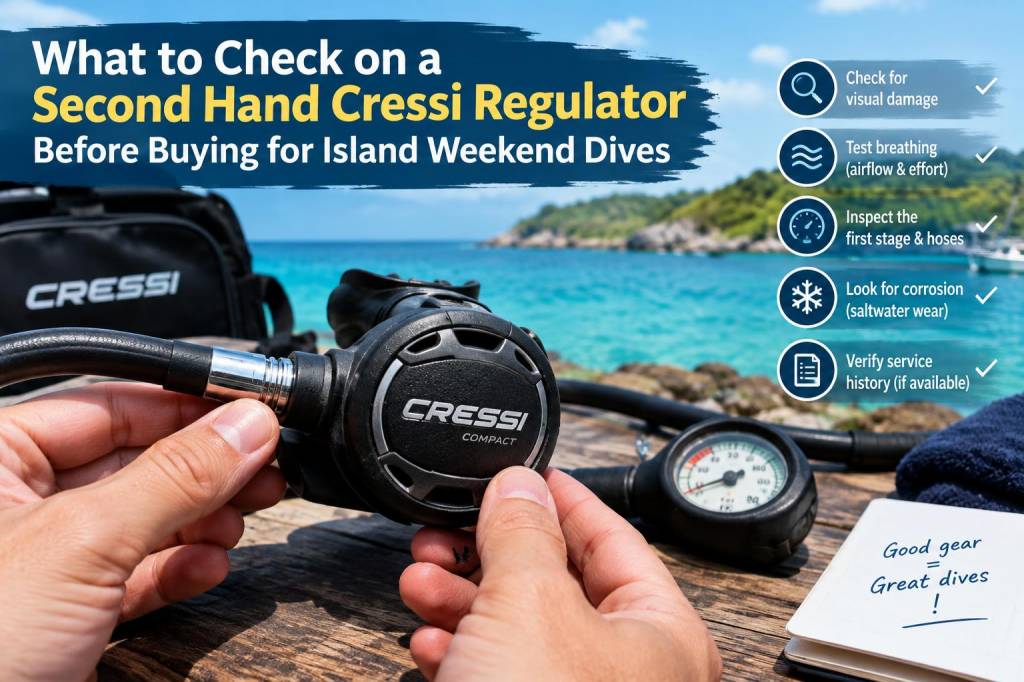
Buying a second-hand regulator can be a smart move when you’re packing light for island weekend dives. I’ve bought a few used sets over the years — some excellent finds, others that taught me the hard way to check more thoroughly. If you’re looking at a Cressi regulator (a common and reliable brand here in the Canaries), here’s my practical, hands-on checklist of what I personally inspect before handing over cash. These are the things that matter for short trips, tight luggage and the local conditions: salt, sand and sometimes gritty shore entries.
Why I look carefully at regulators for island weekend trips
Weekend diving in Lanzarote or other islands rarely demands the same gear redundancy as long expeditions, but you still want a regulator you can trust. A second-hand Cressi can be perfect: they’re robust, widely serviced and parts are available. But regulators are life-support gear — mechanical parts that wear, react to salt and need service. My aim is to find a unit that’s safe, reliable and won’t require immediate servicing after the first dive.
Visual inspection: the first and fastest check
Start with your eyes. I request detailed photos if buying online or arrange to see the unit in person. Here’s what I look for:
- Corrosion and pitting: Check the metal parts of the first stage and any exposed brass or chrome on the second stage. Surface salt can be cleaned, but heavy pitting or green/white corrosion is a red flag.
- Cracks and crazing in housings: Silicone and plastic components on the second stage faceplate and purge button can crack from UV exposure or impact. Small hairline cracks can grow underwater — I avoid those.
- Hose condition: Look for soft, sticky or cracked outer covers on low-pressure (LP) and high-pressure (HP) hoses. Replaceable, but I factor replacement into cost.
- O-ring and DIN/INT thread condition: Inspect the cylinder O-ring on the first stage connection if included, and the threads where it screws onto the tank. Cross-threading marks or stripped threads are deal-breakers.
Functional checks I always do in person
If possible, bring a tank or ask the seller to attach the regulator to a filled cylinder. Many problems are obvious once the regulator is pressurised.
- Breathing effort: With the tank on and the purge button closed, breathe from the second stage. It should inhale smoothly and exhale easily without whistling, large pops or sticking. Cressi’s mid-range models are generally easy-breathing; any roughness suggests a diaphragm or valve issue.
- Free-flow test: Turn the tank off, breathe until the remaining pressure drops, then open the tank again. A brief free-flow on opening is normal as the system equalises, but continuous free-flow is not.
- Purge button and valve function: Press the purge—air should blast cleanly. If the button sticks or the blast is weak, there may be debris or a damaged diaphragm.
- LP ports and HP gauge: Plug in a console or hose to ensure the HP port reads and LP ports don’t leak when pressurised. A small hiss at hose connections when under pressure often means a loose fitting or ageing O-ring.
Smell test and taste (yes, really)
It sounds odd, but a quick smell of the inside of mouthpieces and a light taste test can help. Mildew or strong chemical smells inside mouthpieces or second stages mean poor storage. I avoid gear that smells strongly of solvents or mould — cleaning helps, but these are signs of neglect.
Service history and documentation
Always ask for service records. A regulator with a recent service (within 12 months) is more valuable. For island weekend divers who want to dive right away, a regulator serviced within the last year is ideal. If the seller can show receipts or a tag from an authorised Cressi service centre, that increases my confidence.
- No record but low hours: If the regulator looks clean, has low recorded dives (seller profile or watch logs), and passes functional tests, I may still consider it but budget for an imminent service.
- Unknown history: Treat with caution. Price should reflect the cost of a full service, which can be similar to or exceed the value of older models.
Which parts are inexpensive to replace — and which aren’t
For a weekend diver I’ll accept some replaceable wear items, but there are things I won’t gamble on:
- Replaceable and cheap: Mouthpieces, pads, external O-rings, and sometimes hoses. I carry spare mouthpieces and a small hose kit on trips.
- Moderate cost: LP hoses, second stage rebuild kits, or replacement purge buttons. These are fine if the regulator is otherwise in good shape.
- Expensive or risky: First stage corrosion/pitting, damaged piston or balanced valve issues, stripped DIN/INT threads. These can require major repair or replacement.
Compatibility for island dives and travel
Check whether the regulator uses DIN or yoke (INT) connection. On islands I dive with rental tanks that often have both types, but if you plan to own your valve-equipped cylinder, match the connection. Cressi makes both INT and DIN first stages; ask which you’re looking at and whether adaptors are included.
Price benchmark and negotiation tips
I always compare the asking price with the cost of a new equivalent Cressi and the cost of a service. If the regulator needs an imminent full service, subtract that cost from the asking price. Typical bargains are 30–50% off new if the unit is in good cosmetic condition and recently serviced.
- Bring a checklist (or this article!) and be ready to walk away. Sellers often drop price rather than perform a service.
- Offer to pay slightly more if the seller includes recent service documentation — it saves you money and stress.
Quick checklist table to use on viewings
| Item | What to look for | Pass/Fail |
|---|---|---|
| Exterior condition | No heavy pitting, cracks, or major corrosion | |
| Hoses | No soft spots, cracks, sticky coating | |
| Breathing effort | Smooth inhale/exhale, no odd noises | |
| Free-flow | No continuous free-flow when pressurised | |
| Purge | Strong, consistent purge blast | |
| Service records | Proof of service within 12 months preferred | |
| Mouthpiece | Reasonably clean, replaceable |
Brands and models I trust — and why
Cressi’s MC9 and AC2 combos (older models) are common in the used market and, when maintained, perform well for recreational island diving. The more modern Cressi Compact or Black Edition lines are higher-end and worth paying extra for if you find a clean used set. Keep in mind service parts availability — Cressi is widely supported in Europe, which makes repairs easier if you dive from Lanzarote or nearby islands.
In short: a well-priced second-hand Cressi can be a fantastic pick for island weekends if you do the checks above. If the unit passes the visual, functional and documentation tests — and the price reflects any pending maintenance — you’ll likely have a dependable regulator that won’t let you down on a short break. If you’re unsure, budget for a service before your trip — the cost is worth the peace of mind when you’re on a remote shore entry and the water’s calling.