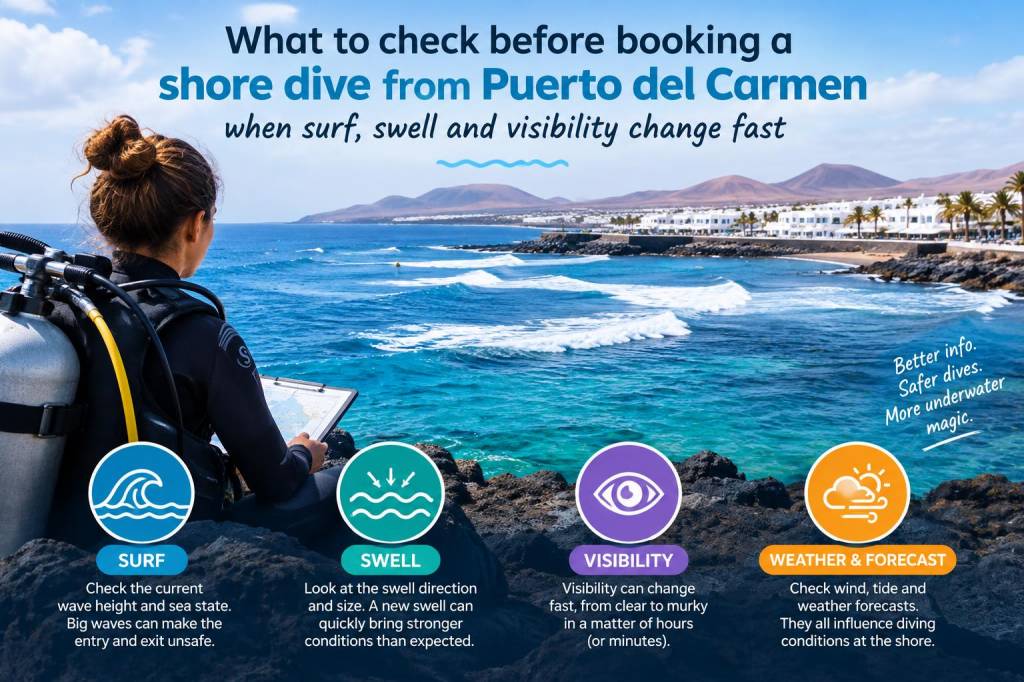
I have learned not to treat a shore dive from Puerto del Carmen as a casual decision. Conditions can shift fast here, and what looks calm from the promenade can feel very different once you are standing on the entry point with fins in hand. I check a few things every single time, even when I know the site well, because surf, swell, wind, and visibility can all change the plan in minutes.
Puerto del Carmen is one of those places where I always want to be honest with myself before I enter the water. It is easy to get excited by the convenience of a shore dive, the warm water, and the chance to be underwater within a few minutes of parking the car. But convenience can make people rush. I have seen divers focus on tanks and cameras while ignoring wave set timing, surge, or a drop in visibility after a wind shift. That is when a simple dive becomes stressful.
What I look at before I even touch my gear
My first check starts long before I reach the shoreline. I look at a few weather and sea data points together, not one in isolation. A low wind forecast does not matter much if the swell is rising. A clear forecast does not help if the tide and surge will make the exit awkward. I want a full picture, because shore entries reward patience and punish assumptions.
I start with these questions:
- Is swell rising or falling through the day?
- Is wind onshore, offshore, or cross-shore?
- Is visibility likely to improve after early morning, or worsen?
- Will tide level make the entry and exit easier or more exposed?
- Am I comfortable with the site if conditions are one level harder than expected?
For me, that last question is crucial. I never plan a shore dive only for the ideal version of the site. I plan for the possible version too. If the water is a little rougher, if the current is a little stronger, or if visibility drops by a few metres, I want to know in advance whether I still like the dive.
Surf and swell are not the same thing
Many divers use “surf” and “swell” as if they mean the same thing, but they do not. Surf is what you feel on the beach and in the shallows. Swell is the longer-period energy arriving from distant wind systems. Around Puerto del Carmen, a day can look manageable from shore while a longer swell still pushes water through the entry zone and creates surge on the rocks.
I pay close attention to swell period, not only swell height. A modest swell with a long period can still move a lot of water and make a rocky entry feel much more active than expected. Short, choppy waves can look messy, but they may be easier to time than a larger, cleaner swell that keeps rolling through with strong energy. The shape of the shore matters too. A sandy slope behaves differently from a boulder entry or a platform with uneven rock.
If I know a site funnels swell into the entry, I assume the exit will be more demanding than the entry. That changes my plan immediately. I may choose a shallower profile, shorten the dive, or decide not to enter at all. There is no award for forcing a shore dive when the ocean is clearly asking for a different plan.
Wind direction changes my confidence fast
Wind matters more than many visiting divers expect. In Puerto del Carmen, even moderate wind can alter the surface enough to affect entry, navigation, and comfort. Onshore wind can push chop into the shallows and reduce visibility near the surface. Cross-shore wind can make the surface drift feel deceptive, especially if you are trying to gear up in the water or stay near a fixed exit point. Offshore wind can flatten the surface a little near shore, but it can also make surface conditions feel unpredictable farther out.
I always ask myself whether the wind direction will help me or work against me during the parts of the dive that matter most. If I am entering from a rocky point, I want the surface as calm and readable as possible. If I am dealing with a long surface swim, I want to know whether the wind will make the swim harder on the return. Wind can also shift the feel of the water temperature, especially when you are wet and exposed between gear setup and entry.
One habit that has served me well is checking whether the wind is expected to strengthen later in the day. A dawn entry can be peaceful, while a midday exit may be much less forgiving. In that case, I prefer to dive early and finish before the surface gets more chaotic.
Visibility can change with tide, wind, and foot traffic
When people ask me what makes a shore dive in Puerto del Carmen feel very different from day to day, visibility is usually near the top of the list. Clear water is not guaranteed just because the site usually offers good conditions. A single weather change can shift suspended sand, alter the colour of the water, or stir up the shallows enough to reduce visibility near the entry.
I watch for three visibility clues before I suit up:
- Whether the waterline looks milky or greenish near the beach
- Whether waves are lifting sand into the shallows
- Whether boat activity, swimmers, or divers are already stirring the site
If visibility is dropping at the surface, I expect the first few metres to be messy. That does not always mean I cancel, but it does mean I prepare differently. I tighten my buddy distance, simplify my route, and avoid depending on visual references alone. I also make sure my torch is ready if I think the site will be darker than usual. A small light can help with reading terrain and keeping contact with a buddy when the water turns hazy.
For new divers, poor visibility can create anxiety very quickly. I have seen people lose confidence not because the dive was unsafe, but because they were not mentally ready for low-contrast conditions. That is why I like to discuss visibility honestly before entering. It is much easier to adapt a plan than to recover from surprise underwater.
Tide timing affects entry, exit, and comfort
I rarely book a shore dive without checking the tide. In Puerto del Carmen, tide level can change the shape of the entry and the amount of exposed rock you need to cross. It can also affect surge, especially in spots where the water funnels over uneven ground. A low tide may expose more of the entry, which sounds useful until you realise that the route becomes more awkward or slippery. A higher tide may give easier water coverage, but it can also mean more movement over certain features.
I think about tide in practical terms rather than as an abstract chart. Will I need to walk farther across rough ground? Will the water cover enough of the entry to make the step-in smooth? Will the exit be easier if I return fifteen or twenty minutes earlier? Tide awareness is not only about safety; it also affects stress levels. A calm dive starts with a calm entry, and a calm exit is just as important.
| Condition | What I check | Why it matters |
|---|---|---|
| Rising swell | Swell height, period, and arrival time | Can increase surge and make the exit harder |
| Onshore wind | Wind strength and gust pattern | Can create chop and reduce surface visibility |
| Low visibility | Surface colour, sand movement, recent traffic | Changes navigation and buddy spacing |
| Changing tide | Tide height at entry and exit time | Alters access, surge, and comfort at the shoreline |
My site choice changes with the conditions, not with habit
One of the biggest mistakes I see is repeating a favourite site without re-evaluating it. I understand why people do it. A familiar shore dive feels efficient and reassuring. But a familiar site can become a poor choice when swell wraps in from a different angle, when the wind line shifts, or when the water looks different from normal.
I ask myself whether I want a relaxed sightseeing dive, a skills-focused dive, or a more adventurous one. Then I match the site to that goal. If conditions are soft and stable, I may enjoy a longer route and spend more time observing the reef structure and fish life. If conditions are more active, I prefer a simpler plan with a clear turn point and an easier exit strategy. I am not trying to prove anything. I am trying to finish the dive feeling good.
That mindset helps with group diving too. If I am with someone newer to shore entries, I do not choose a site that demands too much concentration from the start. I want their attention available for buoyancy, breathing, and buddy awareness, not just for surviving the entry.
What I pack or adjust when conditions look unstable
When the forecast feels changeable, I adjust my kit and my plan. I do not bring more gear just for the sake of it, but I do make small choices that improve flexibility. A good mask, a reliable torch, secure fins, and a surface marker buoy can matter a lot when conditions shift. I also make sure I have a clear route plan and a backup exit idea if the original one becomes less attractive.
My usual adjustments include:
- Using a brighter torch for low-visibility conditions
- Choosing a more secure fin strap setup
- Carrying a surface marker buoy when the surface may become crowded or choppy
- Reducing planned depth if surge is stronger than expected
- Shortening the dive if the exit window looks narrow
I also talk through the plan with my buddy before entering. I want us to agree on turn points, signals, and the exact place where we will end the dive. That conversation takes only a minute or two, but it can prevent confusion later when conditions are less comfortable than expected.
Questions I always want answered before I commit
There are a few questions I keep returning to because they save me from bad decisions. I ask whether the site is still enjoyable if visibility drops, whether I would still feel confident if the swell increases slightly, and whether I can exit without rushing. I also ask whether I am feeling alert and calm enough to deal with a little uncertainty. That last question matters more than many divers admit. Even a good site feels harder when you are tired, distracted, or trying to fit the dive into a schedule that is too tight.
Before I book a shore dive from Puerto del Carmen, I want all the pieces to make sense together: sea state, wind, tide, visibility, and my own comfort level. If one of those pieces feels off, I change the plan rather than hope it improves on its own. That habit has saved me from plenty of frustrating entries and a few genuinely poor calls.