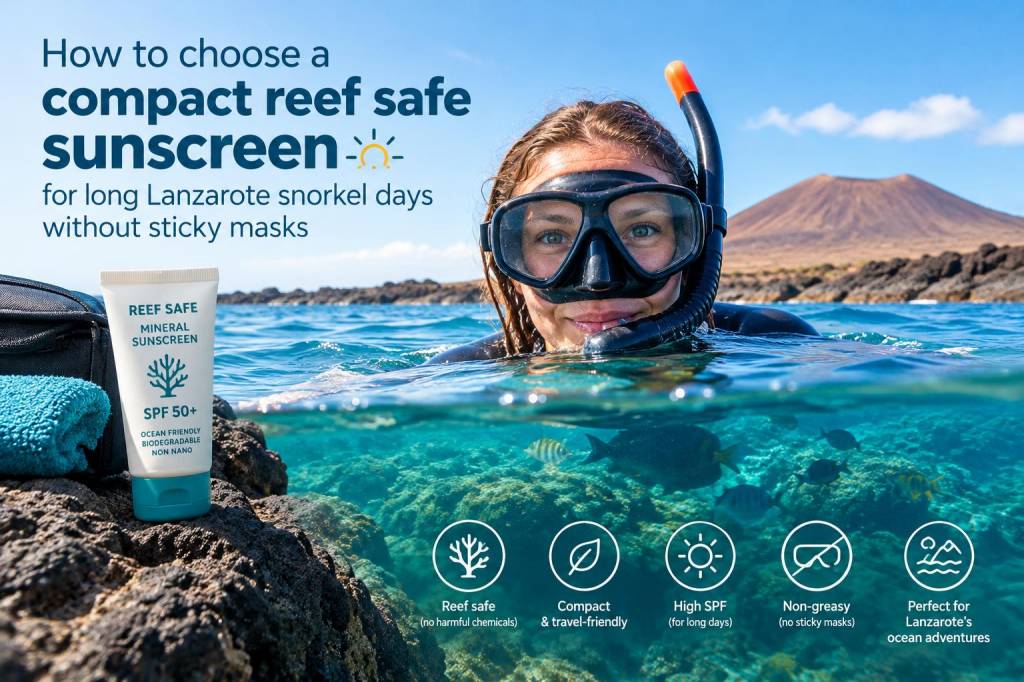
Choosing a compact reef-safe sunscreen for long snorkel days in Lanzarote sounds simple until you are standing on warm volcanic sand, half packed, already thinking about salt, wind, and whether your mask will stay clear. I have learned that a sunscreen can feel perfect on land and still become a problem once you are swimming for an hour, wiping at your face, and trying not to fog your lenses. For me, the sweet spot is a formula that protects well, stays comfortable in heat, and does not leave that greasy film that makes a mask slip or smudge.
What I look for before I buy
I start with protection, because on Lanzarote I never want to treat sunscreen as an afterthought. The island gives you strong sun, reflective water, and often a good amount of wind, which can fool people into staying out longer than they should. I want broad-spectrum protection with high SPF, and I prefer a formula that is designed for water exposure rather than a casual city day. For long snorkel sessions, I usually reach for SPF 30 or SPF 50, depending on the day, the season, and how much time I expect to spend surface swimming or waiting on shore between entries.
Then I look at texture. A compact sunscreen should be easy to carry in a small dry bag or beach pouch, but size alone is not enough. If the cream is too runny, it gets messy in heat. If it is too thick, it can sit heavily on the skin and feel uncomfortable under a mask strap or on the bridge of the nose. I like formulas that spread evenly, settle quickly, and leave a dry or semi-dry finish. That matters more than people think when you are adjusting a snorkel mask several times before entering the water.
Reef-safe is another point I take seriously, although I always read labels carefully instead of relying on marketing words. In my experience, there is no single universal definition that guarantees a product is gentle on marine life, so I look for formulas that avoid obvious problem ingredients and lean toward mineral filters when possible. I also prefer simple ingredient lists over flashy packaging claims. Fewer unnecessary additives often means less irritation for my skin and less uncertainty for the sea.
Why mask comfort changes everything
A sticky sunscreen can ruin a snorkel session faster than a rough entry or a cold current. If the product leaves a slippery layer around your cheeks, nose, and forehead, your mask seal may shift when you move your face in the water. I have had sessions where a tiny film on my skin caused constant micro-leaks, and it became impossible to relax and enjoy the marine life. That is why I test sunscreen like I would test any piece of gear: on a real beach day, with sweat, salt, and repeated mask adjustments.
I pay special attention to three zones: the nose bridge, the upper cheeks, and the hairline. Those areas are often where people apply too much product, and that extra layer is exactly what interferes with a snug fit. I apply a thin first layer, let it settle, then add only a little more if needed. A heavy application might feel reassuring, but for snorkel days it can create the wrong kind of comfort. I want protection without any greasy transfer onto the silicone skirt of my mask.
I also think about how sunscreen behaves after a swim. Some formulas wash off quickly, while others cling better but still feel light. For longer days, especially if I am moving between coves or doing multiple snorkel entries, I need something that remains stable without becoming sticky. If I can feel it on my hands every time I wipe seawater from my face, that is usually a sign I picked the wrong one.
Ingredients I trust more than marketing language
I am not looking for perfection in a bottle, but I am selective. Mineral-based formulas with zinc oxide or titanium dioxide often work well for me because they tend to sit on the skin in a way that feels reliable and controlled. That said, not every mineral sunscreen is comfortable, and not every chemical filter is bad for every situation. What matters to me is whether the formula performs well in water, feels good during activity, and aligns with a lower-impact approach.
For reef-conscious choices, I avoid products that make vague promises without clear ingredient information. I also avoid heavy fragrance when possible. Strong scent may seem pleasant on land, but once you are breathing through a snorkel and getting warm in the sun, it can become overpowering. Fragrance can also irritate sensitive skin, especially when repeated saltwater exposure has already dried it out.
Water resistance is another label I check closely. It does not mean I can ignore reapplication, but it gives me a much better starting point. If I know I will be out for several hours, I want a product that holds up through sweat, wet hands, and quick towel drying. On Lanzarote, I often combine sunscreen with a rash vest or a thin sun shirt, because that reduces how much skin I need to coat in the first place.
What a compact format needs to do
Compact does not simply mean small. For me, it means practical. I want a container that can disappear into a day bag without leaking, cracking, or taking up the space I need for water, snacks, and spare snorkel gear. A tube with a secure cap is usually easier for travel than a bulky bottle. If I am heading to Famara, Papagayo, or a quieter cove with a long walk from the car, I like something that feels light but still gives me enough product for more than one outing.
I also value packaging that is easy to handle with sandy hands. A stiff cap or a twist mechanism is useful when my fingers are wet. A slippery metal tin may look nice, but it can be awkward on a windy shore. The ideal product is one I can use without turning the whole routine into a mess.
Here is the kind of checklist I use before buying:
- High SPF with broad-spectrum protection
- Water resistance suitable for snorkeling and beach days
- Low fragrance or no fragrance
- Light texture that does not feel oily
- Packaging that fits easily in a small day bag
- Clear ingredient information, not vague marketing claims
- Comfort under a mask and around straps
- Easy reapplication without leaving residue on the skin
My application routine before I enter the water
I never wait until I am already at the shore to apply sunscreen. I put it on well before I need it so it has time to settle. That is one of the simplest ways to reduce stickiness around the mask area. I focus on a thin, even layer and give extra care to the back of my neck, ears, and the tops of my feet, because snorkelers often forget those spots when the attention is fixed on the face.
For the face, I use less than most people expect. I apply in small amounts and spread it carefully, rather than loading on a thick layer at once. Around the eyes, I prefer products that stay put and do not run with sweat. If I know I will be in strong sun for hours, I sometimes combine a good face sunscreen with a cap or a visor during the walk to the water, which reduces the amount I need on the face itself.
Reapplication matters, especially after swimming, drying off, or spending time on a boat between snorkel stops. I keep a small tube in an easy-to-reach pocket so I do not skip it because my bag is buried under towels. If I am doing multiple short snorkel sessions in one day, I reapply before each new entry rather than waiting until I am already tired and sun-warmed.
Products and formats I have enjoyed using
I do not think there is a single perfect sunscreen for everyone, but I have had good experiences with compact sticks, small squeeze tubes, and travel-size mineral creams from brands such as Sun Bum, Blue Lizard, Badger, and Eucerin. Some are easier for the face, while others work better for body coverage. I am more interested in performance than in hype, so I often compare texture, scent, and how my mask behaves after application instead of choosing by label alone.
| Format | What I like | What I watch for |
|---|---|---|
| Stick | Fast application, less mess, easy for nose and cheeks | Can feel waxy if overapplied |
| Small tube | Better for even coverage, easy to pack | Can get slippery in heat if texture is too rich |
| Mineral cream | Often good for sensitive skin and reef-aware choices | May leave a white cast if formula is heavy |
| Lotion | Simple for full-body use before a long beach day | May feel too moist under a mask if not absorbed well |
Small habits that make sunscreen perform better
Even a strong product can fail if the rest of the routine is careless. I wash salt and sweat from my face before reapplying, because sunscreen sticks better to clean skin. I keep a soft towel nearby and avoid rubbing aggressively, which can lift the product and create patchy spots. I also try not to touch my mask skirt after applying sunscreen, because even a tiny amount of residue on my fingers can compromise the seal.
If I know I will snorkel in open sun for a long time, I build in shade whenever possible. A short break under a rock overhang, a parasol, or even the shadow of a cliff can reduce how much sunscreen I need to use overall. That is good for my skin and better for the water around me. I also wear a rash guard whenever conditions allow, because clothing is often the cleanest and most effective sun protection available.
Travel size matters when I move around the island. I do not want to carry an oversized bottle to a remote entry point or risk leaving a half-used product baking in a car. A compact sunscreen lets me stay consistent, and consistency is what keeps a long snorkel day comfortable. The less I have to think about my skin, the more I can focus on the water, the fish, the light, and the calm rhythm of floating above the reef.
When I choose a sunscreen for Lanzarote, I am really choosing how the whole day will feel: whether my face stays comfortable, whether my mask seals properly, whether my bag stays tidy, and whether I can enjoy the sea without worrying about slippery residue. That is why I test products in real conditions and pay attention to details that only matter once you are already in the Atlantic, looking down through clear water and hoping nothing in your kit distracts you from the swim.