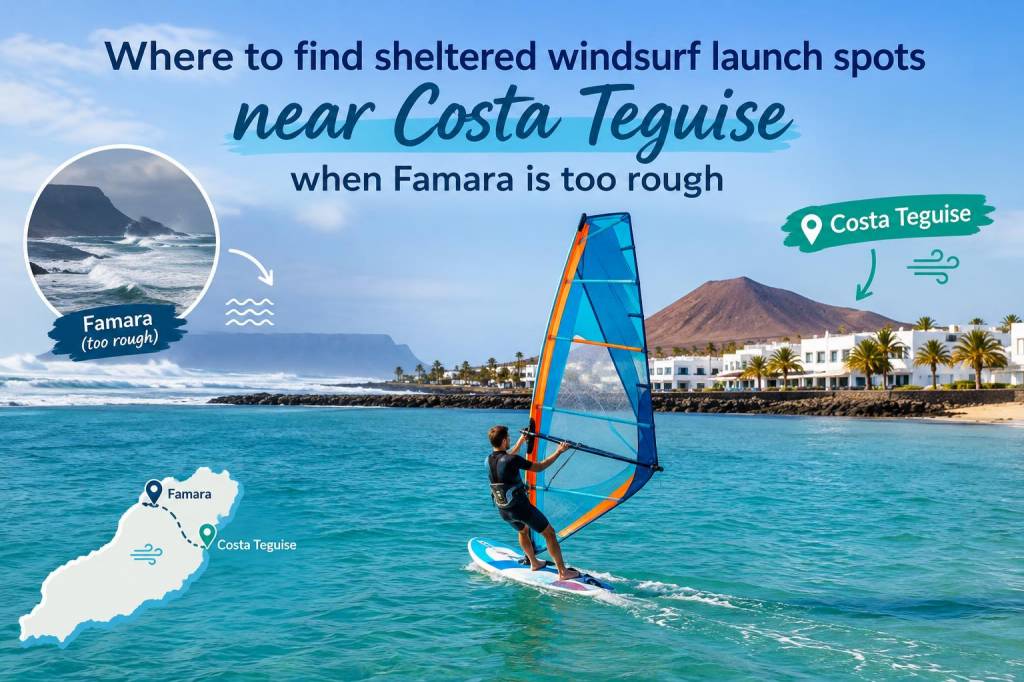
When Famara is too wild, I usually shift my focus east and start looking for launch points near Costa Teguise. Lanzarote can be brutally honest about wind and swell: one day you get smooth ramps and easy waterstarts, and the next day the west coast turns into a heavy, messy machine that is simply not worth fighting. Over the years I have learned that a sheltered session is not just a consolation prize. It can be exactly what you need to work on timing, gybes, sail handling, or simply enjoy a cleaner, calmer ride without getting battered.
Near Costa Teguise, I look for spots that are protected from strong north and northwest swell, have manageable shorebreak, and offer a realistic path for launching and returning without a drama-filled carry through rocks or reef. That matters even more when wind is gusty, because a sheltered bay can still feel lively if the wind is funneling through gaps in the coastline. My usual approach is to check swell direction first, then wind angle, then tide. If any one of those is wrong, I move on rather than force it.
Why Costa Teguise becomes my backup zone
Costa Teguise sits on Lanzarote’s east coast, which makes it a natural refuge when western and northern beaches are getting hammered. Famara can be beautiful, but once the swell builds or the wind lines up badly, it becomes a very different place. East coast bays and coves often stay more organized, especially when the swell has enough north in it to wrap around but not so much that it floods every corner of the shoreline.
I also like Costa Teguise because access is usually straightforward. I can often park close enough to keep the carry short, which matters when I am rigging in crosswind or trying to avoid loading up a sail in gusts. On Lanzarote, convenience is not laziness; it is part of safety. A long awkward walk with gear can turn a marginal session into a bad decision very quickly.
Las Cucharas when conditions are usable
Las Cucharas is the first place many windsurfers think about in Costa Teguise, and for good reason. It is one of the most accessible launch areas on this coast, and on a lighter day it can feel forgiving compared with more exposed beaches. I have used it many times when I wanted a lower-stress start and an easier water entry.
It works best when swell is modest and the wind direction is not pushing too much side-onshore chop into the launch zone. A small day here can still deliver plenty of fun if you want freeride cruising, foil practice, or technique work. If I am teaching or heading out with someone less experienced, this is often where I begin looking because it gives a bit more breathing room than a rough open beach.
Still, I never treat Las Cucharas as automatically safe. Even a “sheltered” spot can become awkward if the tide is high, if the sandbars shift, or if a surge sneaks in around the edges. I always walk the entry first, watch a few sets, and check whether outgoing water is pulling strongly along the shore. If the entry looks messy, I do not argue with it.
Jablillo for smaller water and easier control
Jablillo is another place I consider when I want something calmer than Famara. It is not a magic answer, but in certain conditions it can offer a more protected feeling, especially when wind and swell are moderate rather than aggressive. I like it when I want to keep the session compact and focus on control rather than speed.
What I appreciate most about Jablillo is that it can be mentally easier. Some days you do not need a heroic launch; you need a spot where you can get on the water without committing to a full wrestling match before you even plane. If I am feeling tired, if I want to test a new fin or sail tuning, or if I am returning to the water after a break, that lower-pressure setup is valuable.
It is still essential to judge swell wrap carefully. A place that feels calm from the parking area can hide rebound and chop once you are closer to the waterline. I always give myself enough time to stand still and watch before rigging. That habit has saved me from several unnecessary mistakes.
Playa Bastián on lighter days
Playa Bastián can be useful when I want a gentler start and conditions are clearly on the mellow side. It is not where I would go for a serious powered session, but for lighter wind and flatter water ambitions, it has its place. I have found it especially handy when I want to stay local to Costa Teguise and keep logistics simple.
The main value here is not raw performance. It is accessibility and the possibility of finding a more forgiving environment than the obvious open-beach alternatives. If I am meeting someone who is newer to windsurfing, or if I want to inspect gear adjustments without fighting heavy water, I may keep this spot in mind.
That said, I do not use Playa Bastián when the sea state starts building. If the Atlantic has energy running through the coast, I would rather move elsewhere or wait for another day. My rule is simple: if I can already predict a hard recovery swim from the beach, I am not interested in launching there.
What I check before choosing any sheltered launch
I use a short mental checklist before I commit to a launch near Costa Teguise:
- Swell direction: north and northwest swell can wrap into east-coast corners more than people expect.
- Wind angle: side-onshore is usually more manageable than fully onshore gusts.
- Tide level: high tide can create stronger shorebreak and reduce usable beach space.
- Entry and exit width: I want enough room to carry and clear the water without clutter.
- Current and drift: even small spots can have sideways pull that makes launches tricky.
- Traffic: swimmers, paddleboards, and other water users matter more than people admit.
If any of those factors feels wrong, I treat it as a no. Lanzarote rewards patience far more than stubbornness.
What makes a spot feel truly sheltered
People sometimes think sheltered means flat. It does not. On this coast, sheltered usually means more manageable rather than calm. A spot may still have chop, gusts, and some swell energy, but if the shoreline geometry softens the worst of it, I can work with that. The difference between “manageable” and “bad” is often a few degrees of wind angle or a slightly different tide stage.
I also look for visual clues. A line of rocks, a headland, or a shallow bay can take enough energy out of the water to make a session feel much smoother. Even so, I trust what I see on the day more than any general reputation. Lanzarote changes fast. A bay that was friendly last week may be awkward after a swell cycle or a wind shift.
My approach for rigging and launching in a protected bay
When I know I am heading for a sheltered launch near Costa Teguise, I still rig with caution. I keep gear compact, make sure all lines are tidy, and choose a sail size that leaves room for gusts. If I think I might be underpowered, I would rather rig a fraction smaller and preserve control. A sheltered spot can lull people into overrigging, and that often ends with arm fatigue, bad posture, and a messy return to shore.
I also position the board and sail so that a gust will not pull everything into an awkward angle while I am still on land. If I am alone, I keep my setup simple and close to the water. If I am with others, I still avoid crowding. Launch zones can become chaotic fast when multiple people are rigging at once.
For anyone less familiar with local conditions, I would say this: do not confuse a less exposed beach with an easy day. Use the same discipline you would use anywhere else. Check your leash, inspect your fin, make sure your harness lines are correct, and give yourself time to watch the water before you commit.
When I would leave Costa Teguise alone and wait
There are days when even the sheltered options are not worth it. If swell is wrapping hard into every corner, if wind is gusting violently onshore, or if the water looks confused and unstable from the beach, I wait. That is especially true if I am not feeling fully sharp or if I know I will be tired after a long drive or a previous session. Fatigue changes judgment.
I have also learned not to chase a session just because I already drove there. Lanzarote can tempt you into thinking you must use every gust. I do not. A missed session is cheaper than a damaged board, a strained shoulder, or a dangerous swim back through broken water.
What I carry when I expect a sheltered east-coast session
| Item | Why I bring it | What I watch for |
|---|---|---|
| Light wetsuit or spring suit | Comfort for long sessions and repeated waterstarts | Wind chill can still bite even in mild air |
| Small repair kit | Quick fixes for rigging issues | Loose screws, torn battens, damaged footstraps |
| Water and snack | Energy for rigging and recovery | Hot days drain you faster than expected |
| Phone in waterproof pouch | Navigation and emergency contact | Battery level before launch |
| Extra fin key | Useful after travel or tuning changes | Never assume one tool will survive everything |
I keep that kit lean, because I prefer moving easily across the beach, but I never go so minimal that I lose flexibility. On this island, small practical details make a real difference.
What I tell friends asking where to launch near Costa Teguise
If a friend asks me where to go when Famara is too rough, I usually answer with a calm, condition-based reply rather than a single magical spot. I point them toward Las Cucharas first, then Jablillo, then Playa Bastián if the day is very light and the sea is settled. I also tell them to spend a few minutes watching the water before deciding anything. That pause is worth more than any online forecast alone.
I like these east-coast options because they give me choices. Sometimes I want a relaxed freeride session, sometimes I want to practice turns, and sometimes I just want to stay on the water without fighting a heavy launch. Costa Teguise gives me that flexibility more often than people expect, as long as I respect what the sea is doing on that particular day.
And when I am standing on the beach with rigging in hand, I still ask myself the same question every time: does this launch make the session safer, cleaner, and more enjoyable, or am I trying to force a day that does not want to happen? That question usually tells me where I should go next.