Why this upwind transition matters at Famara
Famara’s cross-shore temperament rewards clean technique: if you get your upwind transition right you’ll keep board speed, conserve energy and avoid the classic stall-and-drift that ruins a run. I’ve taught dozens of students and logged hundreds of sessions here — the same simple, repeatable sequence works whether the wind is a steady 20 knots or a gusty 30 with big gust-drop cycles. This article breaks down the step-by-step movements I use and teach, plus the small setup details that make them reliable in Lanzarote’s conditions.
The goal: smooth, fast, low-effort upwind transitions
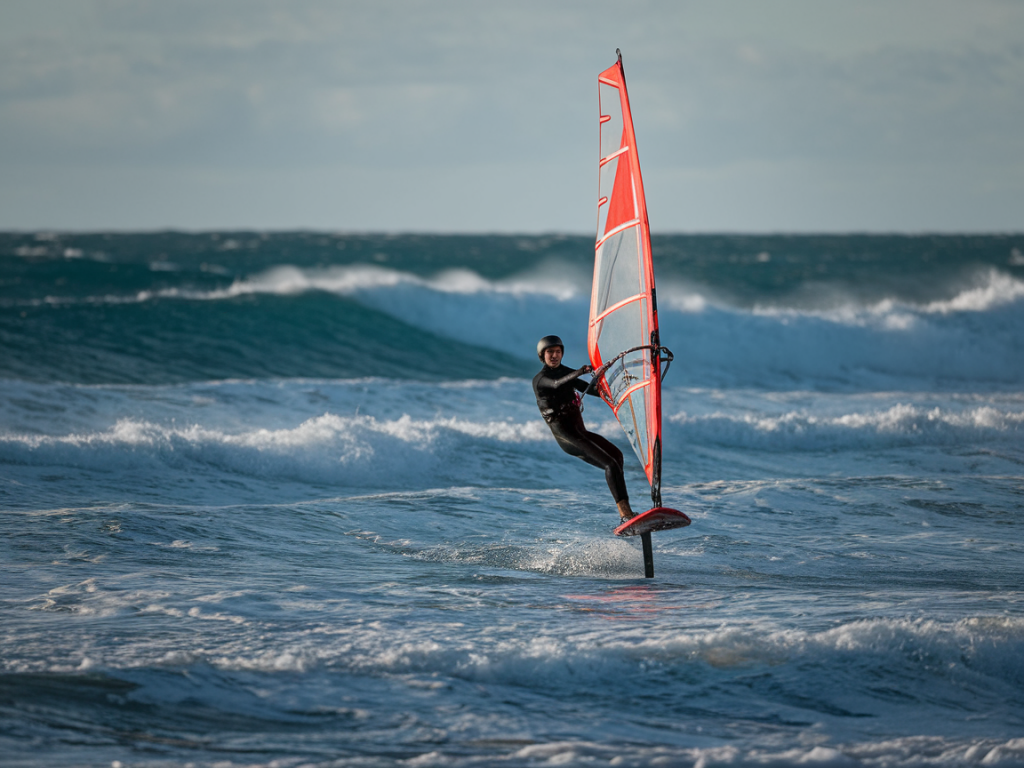
When I say “upwind transition” I mean the moment you change body position, sail trim and board pressure to point higher into the wind without losing speed. The ideal outcome is to feel the board drive forward and lift into the new angle while your load moves smoothly from one foot to the other and the sail keeps clean airflow.
Quick checklist before you sail out
- Board: slightly flatter rocker, good rail-to-water contact (freeride/foil boards work well). I prefer a board with stable early planing if conditions are gusty.
- Sail: responsive but not overpowered — on Famara I often choose a sail with a forgiving luff curve and a little top-end control (like a 5.2–5.8m for intermediate riders in 20–28 knots, depending on weight).
- Harness: use a supportive waist harness for cross-shore runs to keep your upper body settled and avoid excessive arm fatigue.
- Fin: a medium-to-large center fin gives grip during the upwind carve; too small and you slip sideways during the transition.
Set your rig for a forgiving, powerful transition
Small rig tweaks make big differences when the wind is shifty. I set a touch more downhaul than I would for pure reaching so the sail depowers faster in gusts and re-powers predictably when I sheet in. Outhaul is slightly on the looser side to keep top-end power for short bursts during the transition. Harness lines should be in a mid-position so I can easily adjust leverage with my arms.
Step-by-step transition technique
Practice these steps in sequence until they become a fluid motion. I coach riders to rehearse the hand movements on land and in shallow water before doing them at speed.
- Anticipate the angle change — Eyes up, spot your new upwind heading early. Famara gusts mean you don’t want to wait until the wind drops to start the move. I start preparing while still in planing mode.
- Trim the sail and compress — A half-sheet out for a split second helps keep the nose down and stops the board catching. At the same time, compress by bending both knees slightly and drop your weight down low. This stores energy in the legs to be released into the carve.
- Back foot pressure to edge — Press down on your back foot and roll onto the inside rail (the rail that will dig into the water as you point upwind). The back foot controls board angle; my cue is “bite the rail with the heel.”
- Front foot readjustment — As the board begins to hold the rail, slide your front foot a few centimetres forward to regain control of nose lift. Avoid snapping the foot too far forward — incremental moves keep balance steady.
- Smooth hand swap (if needed) — If you need to change tack, swap hands when the sail is lightly sheeted and close to your body. Keep the sail high enough to maintain drive; dropping the mast or letting the sail stall kills forward momentum.
- Re-sheet and drive — Once the board is on the new edge, sheet in steadily. Do not yank the sail; a progressive sheet-in lets the board accelerate into the new upwind angle rather than stall.
- Release into the harness — Move load into the harness early so your arms relax and you can fine-tune trim with core and hips. On longer upwind legs I lock in harness power and let my legs handle subtle steering.
Key body-language cues I teach
- Look where you want to go — Vision changes balance. If you look upwind your hips and shoulders will follow.
- Low center of gravity — Knees bent, chest down, weight over the back foot during the carve phase.
- Hands steady, not frantic — Use your back hand to control angle, front hand to trim power. Small, deliberate movements beat big corrections.
Common mistakes and how to fix them
- Over-sheeting early — Students often pull the sail hard right away; this stalls the board. Fix: compress, roll the rail, then sheet in gradually.
- Sitting too far back — Causes nose to lift and lose planing. Fix: move front foot slightly forward and push weight into the front third once on the new edge.
- Hand swap at the wrong moment — Swapping when the sail is fully powered creates a wobble. Fix: swap with the sail nearer your body and slightly depowered.
- Wrong fin size — Too small = sideways slip; too large = sluggish turns. Use a fin that matches your board and the local chop (I use a slightly larger fin on Famara than I would in flatwater).
Adaptations for gusty Famara conditions
Famara mixes smooth offshore gusts with messy shore chop. To handle this:
- Expect sudden gusts — keep a slightly looser outhaul so the sail can depower without you losing control.
- Shorten your transitions in lumpy sections — focus on basic sequence without extra flourishes.
- Use a slightly wider stance than in calm water — it increases stability when the board squirms.
Gear that helps save energy and speed
| Board | Freeride or hybrid with early planing and comfortable footstrap positions |
| Sail | Playable sail with a soft leech and good bottom-end power (brands I trust: NeilPryde, Duotone, GA Sails) |
| Fin | Medium-large, balanced rake for grip without excess drag |
| Harness | Waist harness with good lower-back support to transfer load efficiently |
Drills to practise this sequence
- Slow-motion transitions — Plan at low speed and exaggerate each phase: compress, edge, slide front foot, sheet in. Repeat until the timing feels natural.
- One-handed runs — Ride with one hand to develop balance and better foot control before reintroducing full-power sheets.
- Rail-hold intervals — Focus on holding the rail for 5–10 seconds without shedding speed; this builds confidence that the board will not slip sideways.
How I coach nervous riders on Famara
Start in calmer spots and build to the beach break. I keep initial runs short and focus on one change at a time — often just the front foot move or the back foot pressure — until it's automatic. I also film students from shore; watching the replay speeds up learning because they can see small timing issues that feel different in the body.
If you’re planning a session and want a personalised check, drop a message through the contact page on https://www.scubalanzarote.co.uk — I’m usually guiding or coaching on Famara and can suggest specific sail sizes and setup tweaks for the day’s conditions. See you in the water — and remember: controlled, small adjustments beat big, exhausting corrections every time.