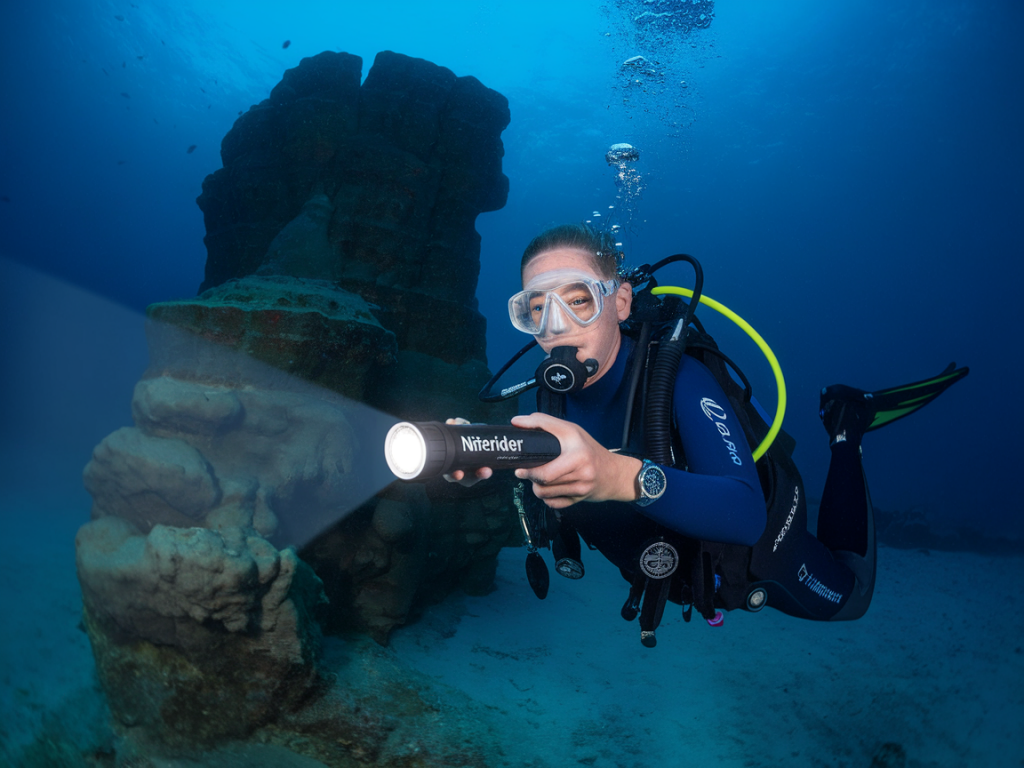
Night diving around Lanzarote is an entirely different animal than daytime diving. The volcanic seabed, hidden crevices and dense life on the reefs mean you need a torch that can do two things well: punch out a long, usable beam for navigation and search, and offer a soft, well-controlled spill or diffuser for macro work without frying shy critters with a spotlight. Over the last two seasons I tested three popular lights in real local conditions — the NiteRider Pro 1600 (example model), the Oceanic Mini Torch 1200, and the Scubapro Nova 850 — on night dives from Playa Blanca to La Santa and the rocky reefs off Órzola. Here are my real-world impressions and what I’d choose for different kinds of Lanzarote night dives.
Why Lanzarote night dives are special
Lanzarote’s islands are exposed to Atlantic swell and clear water much of the year, but many dive sites are shallow, with steep volcanic rock faces, caves and pockets where critters hide. That means:
What I tested and how
I concentrated on three typical tasks that matter here: long-range beam work (finding a swim-through or reading a depth wall), close-range macro illumination, and practical everyday use (mounting, overheating, battery life). On each dive I used the lights both handheld and on my helmet/head band. Conditions varied: one site had surge and sand, another was calm with 20+ m visibility, and I did night dives at around 10–20 m depth where most of our local macro action happens.
Performance summary table
| Feature | NiteRider Pro 1600 | Oceanic Mini 1200 | Scubapro Nova 850 |
|---|---|---|---|
| Max output (nominal) | 1600 lm — punchy beam | 1200 lm — balanced | 850 lm — softer, uniform |
| Beam pattern | Tight, long throw + narrow spill | Medium throw + controllable spill | Wide, diffused beam ideal for macro |
| Battery life (practical) | ~1.5–2 hr full; 3–5 hr eco | ~2 hr full; 4–6 hr eco | ~2.5–4 hr full; excellent on low |
| Heat management | Gets warm on max, cuts to protect | Good thermal design; stable output | Stays cool; consistent beam |
| Mounting options | Hand, clamp, head mount | Hand, cradle, head mount | Hand, dedicated diffuser & mount |
| Price (approx) | Higher range | Mid range | Lower-mid range |
How they handled macro work
For close-up imaging and searching in crevices, beam softness and ability to modulate brightness are what I care about. The Scubapro Nova 850 was my favorite here. Its wider, more even beam illuminated the entire rock face without a sharp hotspot — that’s kinder to nudibranchs and makes macro photography simpler because you don’t get blown-out highlights next to black shadows.
The Oceanic Mini 1200 sat in the middle. With a diffuser or by angling the beam and reducing power it performed very well for small critters. On its own at full power it could be a little harsh, but the adjustable output and stable beam made it versatile.
The NiteRider Pro 1600 is a beast for range but less ideal for delicate macro unless you use a diffuser or clip it down to low power. Its tight hotspot is fantastic for long throws but tends to "burn" small subjects when you’re 30–40 cm away. I learned to feather it and keep the beam grazing the rock rather than pointing directly into the animal.
Beam and navigation — who wins
For searching a swim-through or scanning a wall on a night dive the NiteRider takes the lead. Its long throw allows you to pick out shapes and navigate along vertical faces from a distance — particularly useful when currents make it hard to get close. The Oceanic also performs well, especially at medium ranges, and I liked its balance when I needed both reach and spill.
Scubapro’s Nova is less about reach and more about comfortable local illumination. If your priority is staying close to the reef and doing detailed searching for critters, it’s excellent. But if you’re buddy-swimming along the coast and need to see far ahead, you’ll feel the limits.
Battery, heat and reliability in Lanzarote conditions
Battery life is where tests in Lanzarote’s real conditions really mattered. Cold Atlantic nights aren’t extreme, but repeated surface intervals and long boat rides mean you can’t rely on single short sessions. The Oceanic's thermals were the most reliable; it kept stable output longer. NiteRider delivers big power but throttles when hot — it’s predictable but you must plan for eco modes. Scubapro stayed cool and consistent, which is reassuring for long macro sessions.
All three survived sand, splash and a bit of surge without fail. I always rinse and open batteries for long-term care, but for weekend rental or guide use the designs are robust. I’d be cautious with any light that uses proprietary, expensive batteries if you plan long multi-day trips — spare battery availability is a real-world consideration in Lanzarote.
Mounting and handling — practicalities that matter
Which I recommend for different divers
Practical buying tips for Lanzarote divers
If you want, I can share example models I tested with links to local shops in Lanzarote and a short checklist for packing and maintaining torches between dives. Tell me whether you mostly do night critter-hunting or search-style navigation and I’ll suggest the best specific model and accessories for your trips around the island.