I have packed camera kits for lava ridges, black-sand coves, salt spray, and reef entries with a backpack already full of fins, water, snacks, and a spare layer for wind. Over time, I learned a simple truth: a waterproof camera setup only works well when it is small enough to carry, quick enough to use, and protected enough to survive sand, knocks, heat, and waves. If it is bulky, I leave it behind. If it is fussy, I stop using it. So my packing system is built around one idea: carry less, fail less, and shoot more.
For volcanic coast hikes and reef swims, I want a kit that does three jobs at once. It has to be safe against splash and submersion, light enough for long walks over rough ground, and fast to deploy when a turtle, cove, or wave pattern appears. That balance changes what I bring, what I leave at home, and even how I store each item inside my bag. I do not pack for studio perfection. I pack for salt, movement, and changing conditions.
What I actually carry and why I keep it small
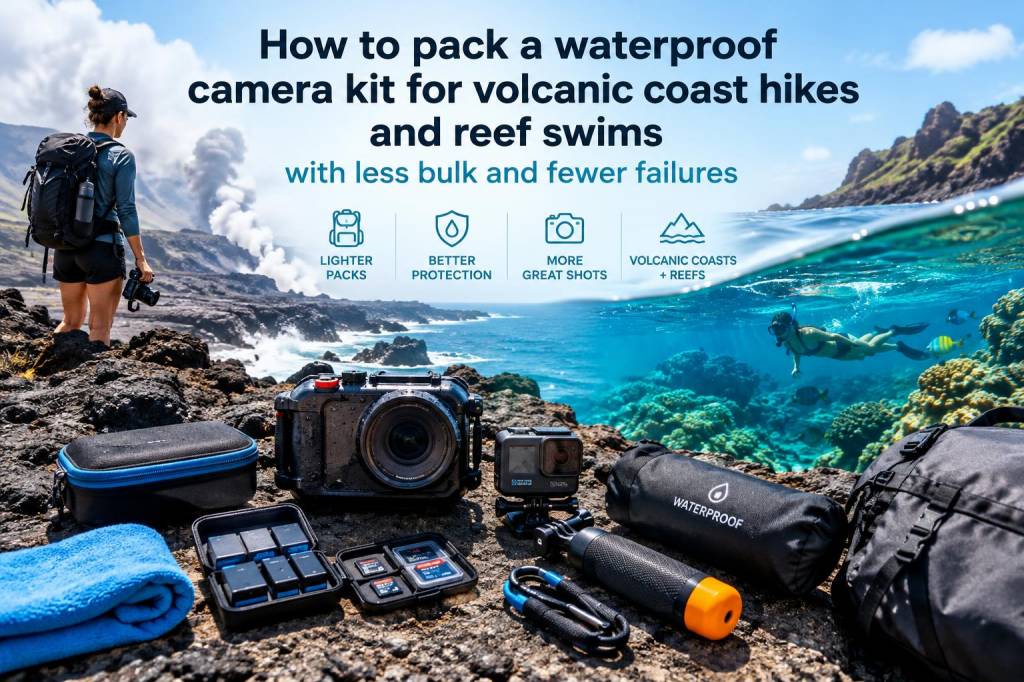
My default setup is usually a compact camera or action camera, a reliable housing, a floating wrist strap, two microfiber cloths, a few silica gel packs, a small lens cloth, a spare battery, a memory card, and a soft dry pouch. If I expect more serious shooting, I may add a small tray and a single light, but only if I know I will need it. Extra gear feels reassuring at home and annoying on a cliff path.
I prefer a compact system because volcanic terrain punishes heavy kits. Sharp lava stones, uneven steps, and exposed tracks make balance more important than image complexity. When I carry less, I move more freely, keep both hands available, and reduce the chance of dropping anything on rock. A smaller kit also fits better inside a daypack with food, water, and safety items, which matters more to me than having every possible accessory.
I have also learned that a waterproof setup should be easy to rinse, dry, and repack. If a cable, mount, or adapter takes too long to handle, it becomes a weak point. Anything I pack needs to justify its space by being useful on more than one type of outing.
Housing choice matters more than camera brand
People often ask me whether camera brand matters most. For this kind of travel, I think housing choice matters more. A solid housing with a clean seal, a clear latch, and a reliable depth rating does more for peace of mind than a fancy body wrapped in poor protection. I check the O-ring carefully, make sure it is clean, and store it away from dust and sand. I also test every housing in fresh water before a real swim, even if I have used it before. Saltwater does not forgive lazy habits.
If I am using an action camera, I like a simple waterproof housing or a trusted native waterproof body with an added float and lanyard. If I am carrying a compact camera, I choose a housing that gives me enough control without becoming oversized. The more buttons and seals a system has, the more time I spend checking them. That is fine for planned dives, but on a hike-and-swim day I want fewer moving parts.
One thing I never skip is a quick pre-trip seal check. I close the empty housing, submerge it in a sink or bucket, and look for bubbles or moisture inside. It takes very little time and can save a camera from a very expensive bath.
How I reduce bulk without losing useful flexibility
The easiest way to cut bulk is to stop packing for imaginary problems. I ask myself a few direct questions before each outing: Will I really change lenses? Will I need a tray? Will I film continuously, or only during short moments? Do I need a full charger, or just a battery bank and one spare battery? Honest answers remove weight fast.
- I use one camera body, not two
- I carry one spare battery, not a full box
- I bring one memory card with enough capacity, not several small cards
- I pack one cloth for drying, one cloth for optics
- I avoid oversized hard cases unless transport is rough enough to need them
For many of my Lanzarote days, a soft padded pouch inside a dry bag works better than a rigid case. It saves room, fits around other items, and still protects against knocks. On volcanic trails, every saved centimeter matters because I want space for water, sun protection, and a small emergency layer. If my camera section starts taking over my pack, I know I have overpacked.
I also choose accessories that serve more than one purpose. A floating wrist strap is not just for security; it also helps me handle the camera in surf or while climbing over rocks. A dry bag is not just for camera storage; it can hold a phone, keys, and a snack if weather changes. Simple gear that adapts is always easier to live with than a pile of specialty items.
My anti-failure routine before a hike or swim
The biggest camera failures I have seen were not dramatic. They were boring mistakes: a dirty seal, a half-closed latch, a drained battery, a fogged lens, or a card that was never formatted. I prevent those with a routine that takes a few minutes and saves a lot of frustration.
Before I leave, I do this:
- Charge every battery fully
- Format the memory card in camera, not on a computer
- Inspect seals for sand, hair, and dried salt
- Put silica gel inside the housing if appropriate
- Check that the camera powers on and records properly
- Carry a clean cloth in an easy-to-reach pocket
Heat is another hidden problem here. On a volcanic coast, a camera left in direct sun can warm up fast, and that can affect battery life and increase fogging once you enter cooler water. I keep my kit shaded whenever possible and avoid opening the housing in dusty wind. If I need to swap batteries, I do it in a sheltered place and keep the camera away from sand while it is open.
Fogging has ruined more pretty underwater moments for me than any wave ever did. I reduce that risk by letting the camera acclimate before use and by storing silica gel with it between outings. If the housing is coming from a cool car into warm humid air, I give it time before sealing it for the swim.
What I carry for reef swims versus cliff walks
My packing changes depending on whether I am spending more time on land or in water. For a reef swim, I focus on quick access, flotation, and rinseability. For a long coastal hike, I focus on compact storage, impact protection, and low weight.
| Item | Reef swim | Volcanic hike |
|---|---|---|
| Camera | Easy access | Deep inside padded pouch |
| Float strap | Essential | Still useful, especially near water |
| Dry bag | Small to medium | Medium, with room for layers and snacks |
| Extra light | Only if visibility needs it | Usually left behind |
| Cleaning cloth | Immediate use after exit | Kept in outer pocket |
For reef swims, I also think about entry and exit points. If I need both hands free for slippery rock, a camera clipped to me must be secure and not swing wildly. A short leash or wrist setup works better than a long dangling strap. For hikes, I keep the camera wrapped and padded until I reach a safe spot, because scrambling with exposed gear is asking for trouble.
Small habits that save a camera near salt, sand, and waves
I rinse gear as soon as I can after salt exposure, but I do it gently. I do not blast buttons or force openings while salt is still on the housing. I let it soak briefly in fresh water, then dry the exterior before opening anything. That habit protects seals and keeps salt crystals from grinding into moving parts.
I also avoid changing cards or batteries at the edge of the sea. Wind pushes grit everywhere, and sand can enter a housing faster than people expect. If I need to reset the setup, I step back from the shore, use a clean surface, and take my time. A patient thirty seconds often prevents a ruined afternoon.
Another habit I swear by is a simple pocket layout. One pocket for dry cloth, one for spare battery, one for card case, one for small tools if needed. When each item has a place, I do not dig around in panic while standing in salt spray. That sounds minor until you are balancing on uneven rock with a wave line changing every few minutes.
When I leave gear at home on purpose
Some of my smartest packing decisions are the things I do not bring. I leave extra mounts behind if I know I will use only one. I skip big dome accessories unless I am planning a session that truly needs them. I avoid heavy batteries and bulky chargers when a single spare and a power bank will do. I do not pack a long list of backup pieces unless the day is remote enough to justify them.
That restraint has made my kit more reliable. Fewer items mean fewer points of failure, fewer zips to manage, and less stress when conditions change. It also means I am more likely to actually use the camera instead of feeling weighed down by it. For me, a good waterproof camera kit is not the one with the most features. It is the one that disappears into the day until I need it, then works without drama.