Snorkeling

how to safely snorkel with eagle rays at night off lanzarote: entry points, torch setups and buddy signals

how to safely snorkel with eagle rays at night off lanzarote: entry points, torch setups and buddy signals

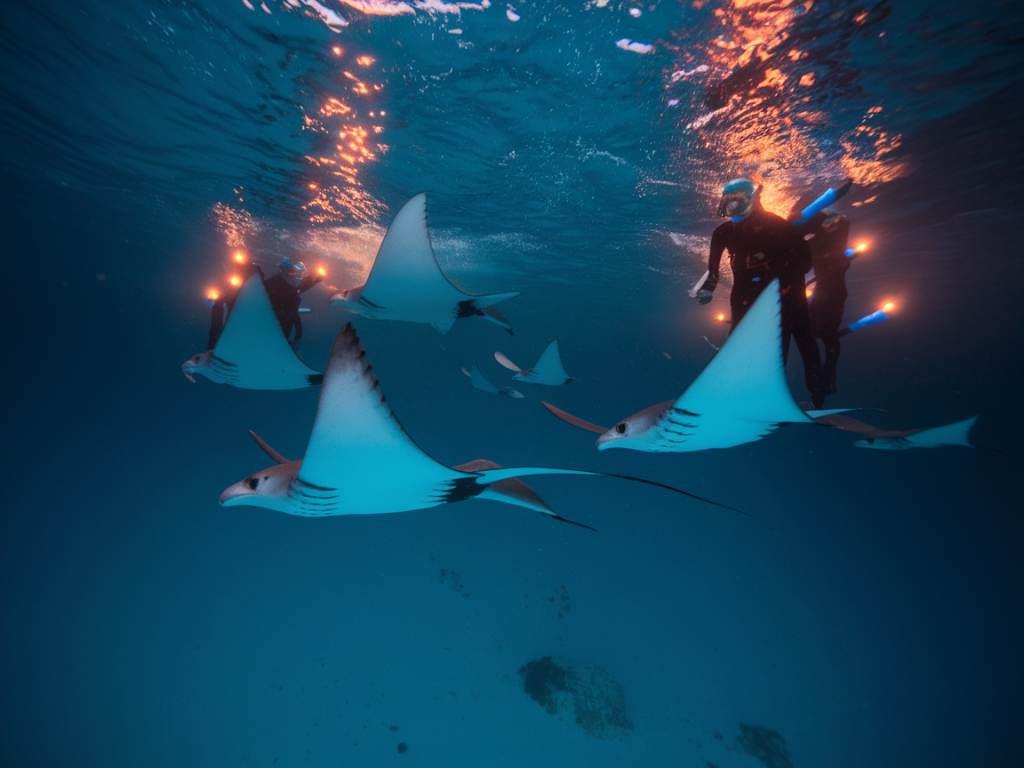
I remember the first time I slipped into the warm black water off Lanzarote at midnight and watched a ghostlike shadow glide past — an eagle ray, as graceful as a glider. Night snorkeling with eagle rays is one of those island experiences that stays with you: quiet, a little wild, and utterly mesmerising. But it’s also an activity that needs respect, planning and the right kit. Below I share exactly how I approach these trips: where I enter, how I set up torches, the signals I use with my buddy and practical safety tips from a dive instructor’s point of view.

Why night and why eagle rays?

Eagle rays are primarily active at dawn, dusk and at night when they forage for crustaceans and molluscs. On Lanzarote, their silhouettes are often seen along sandy bottoms and near shallower reef edges. Night amplifies their beauty — their pale undersides glow under beam light and their long tails trail like ribbons. But night also reduces visibility, hides hazards and changes how other animals behave. That’s why we treat every night snorkel as a careful, guided exercise rather than a spontaneous dip.

Best entry points around Lanzarote

From experience, these are reliable spots where eagle rays are commonly sighted at night and where entry/exit is straightforward. I usually pick my location based on sea state, moon phase and local intel from dive centres.

  • Playa Blanca (Papagayo coves) — sheltered coves with sandy bottoms; good for calmer nights and easy exits. Park early and walk light to avoid disturbing residents.
  • Playa Chica, Puerto del Carmen — short rocky entry with a clear slope to sand; good when currents are light. There are nearby dive shops if you need an extra torch or advice.
  • La Santa (west coast) — more exposed but excellent for larger rays when swell is minimal; approach with local knowledge about currents.
  • Las Conchas, La Graciosa — if you’re island-hopping, this sandy bay produces regular night sightings, but plan the boat trip and exit carefully.
  • Tide, moon and weather considerations

    Before any night trip I check:

  • Low vs high tide — I prefer a mid to low tide for clearer sandy areas; strong tidal flows can make snorkelling difficult or push you off your intended zone.
  • Moon phase — a new moon gives darker conditions and more contrast with your torch beam, which can make rays easier to spot. A full moon provides more ambient light and can be useful for safer navigation.
  • Wind and swell — even small swells reduce visibility and make exits tricky. If in doubt, postpone.
  • Gear and torch setups I use

    My ethos is simple: keep it reliable, comfortable and redundant.

    Item Why I choose it
    Mask and snorkel (low-volume) Better fit, less fogging at surface. I prefer tempered glass masks from brands like Cressi or Mares.
    Wetsuit (2–3mm) Warmth without bulk for summer nights; I use a shorty or full 3mm depending on the month.
    Primary torch (handheld or headlamp) High-lumen LED (1,000 lm+ for handheld) — I like brands such as SeaLife or GoPro-attachable lights for consistent beam and colour rendering.
    Backup torch Always carry at least one spare — a compact backup clipped to your BCD or belt, or a second head torch.
    Marker light / surface buoy Fluorescent float or strobe for boat visibility and to mark your position to shore.
    Dive knife / shears Small cutting tool for entanglement risk (only carried if trained to use).

    Torch techniques and what to look for

    How you use the torch changes the animals’ behaviour. The goal is to observe, not dazzle. My routine:

  • Start with a dim beam — let your eyes adjust to the dark. Suddenly shining a very bright light can startle wildlife and kill your night-adapted vision.
  • Use a wide beam for scanning the sand and reef edges. Switch to a directional beam when you have located a ray to highlight movement and body shape.
  • Keep the beam low and slightly off to the side rather than pointed directly at the ray’s eyes or from above.
  • If a ray approaches close, reduce brightness and hold still — often they’ll pass within arm’s reach if they’re foraging and undisturbed.
  • Buddy system and hand signals

    Never snorkel alone at night. I snorkel with a buddy I’ve briefed thoroughly. We agree on distance, pace and emergency actions before entering.

  • Close buddy (touch contact) — we usually stay within an arm’s reach. If visibility worsens I move to touch contact.
  • Signals I use:
  • Tap shoulder then point down — “I see something below”
  • Wave torch in small circles — “safe to approach/look”
  • Flash torch slowly three times — “move back/retreat”
  • Rapid continuous flashing — “emergency / need immediate assistance”
  • Fist raised above head at surface — “all good / ready to exit”
  • Behaviour around eagle rays — do’s and don’ts

  • Do stay calm and move slowly. Sudden splashes or frantic movements can scare rays into a fast escape.
  • Do give them space. Even though they may come close while feeding, avoid chasing or swimming directly at them.
  • Don’t touch the rays. Their skin and sting (tail barb, in some species) can be sensitive — keep hands tucked unless you’re trained and the animal is clearly habituated and calm.
  • Don’t shine lights in their faces. Use side or downward lighting to observe.
  • Emergency and exit planning

    I plan exits before I enter water: locate the easiest exit point, mark it with a buoy if necessary, and agree on the maximum time in water. If someone panics:

  • Bring them to surface gently and support their head. Use your marker light so the shore or boat sees you.
  • If entanglement occurs, keep the victim calm while you cut lines; carry a knife and know how to use it.
  • Always carry a mobile or VHF on the boat/shore contact and let someone know your ETA back.
  • Local etiquette and conservation

    We share these waters with local fishermen and conservation groups. Be mindful of no-go zones and marine reserves. If you see nesting areas, seabirds or anchored fishing nets, avoid the area. I often coordinate with local dive centres — they’ll share recent sightings, tide info and any environmental notices.

    Packing checklist (quick)

  • Mask, snorkel, fins
  • Wetsuit (appropriate thickness)
  • Primary torch + backup torch
  • Surface marker/strobe and whistle
  • Small cutting tool (if trained)
  • Spare batteries or charging bank
  • Water, light snack, first aid kit
  • Night snorkeling with eagle rays around Lanzarote is one of those experiences that rewards respect and preparation. Do it with a buddy, use the right lights, keep your distance and let the animals do their thing. If you’d like, I can recommend local operators who run guided night snorkels — they’re a great option if you’re new to the area or want the extra reassurance of a guide and boat support.
    You should also check the following news:

    what to pack and test for a one-tank nitrox deep dive from puerto del carmen (checklist and pre-dive drills)
    Diving

    what to pack and test for a one-tank nitrox deep dive from puerto del carmen (checklist and pre-dive drills)

    I dive regularly from Puerto del Carmen and one thing I never skip is a careful packing and...

    how to choose and size a windsurfing harness for famara: comfort, hook types and when to switch to a pro model
    Windsurfing

    how to choose and size a windsurfing harness for famara: comfort, hook types and when to switch to a pro model

    Famara is one of those spots where the wind, waves and long runs invite you to spend hours on the...