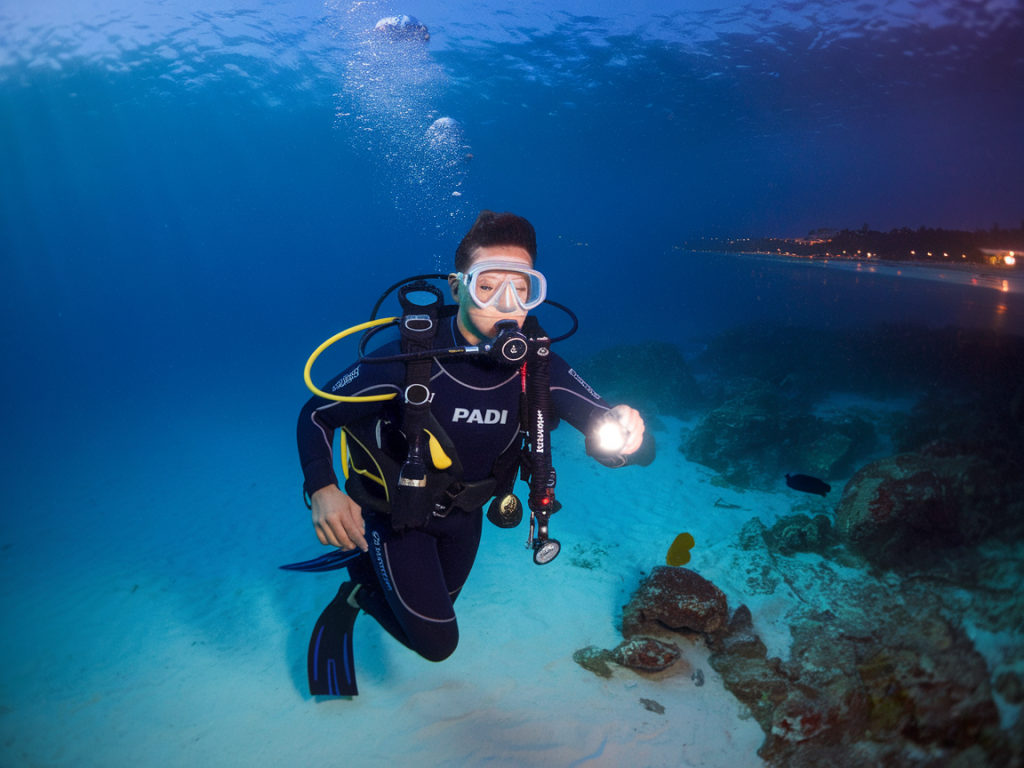
Playa Chica is one of my favourite spots for night diving in Lanzarote—sheltered bay, easy shore access and a seabed that comes alive after sunset. If you’re booking your first guided night dive with a PADI instructor, here’s a step-by-step, practical walk-through of what to expect and how to get the most from it. I’ll cover gear, safety, signals, common wildlife, and the little habits that keep the experience relaxed and magical.
Why choose a guided night dive?
Night diving is a different world: the same reef looks entirely new when illuminated by your torch. For a first night dive I strongly recommend going with a PADI instructor because they manage line work, light discipline and navigation so you can focus on the marine life. At Playa Chica the shore entry is straightforward, but the darkness changes how you orient yourself and judge distances. An instructor reduces stress, points out critters you’d otherwise miss, and handles emergency procedures.
Before the dive — booking and expectation setting
When you book, tell the dive centre your experience level and any concerns (e.g. claustrophobia, night anxiety). Most shops will require you to have at least an Open Water certification—some accept confined-water plus a check-out depending on local rules. Ask about group size (I prefer groups of 4–6 for night dives), instructor ratio, and whether they provide surface marker buoys (SMBs) and reels.
Practical things to confirm:
Pre-dive briefing — read this closely
The briefing is essential. A good instructor will cover:
I always listen carefully to the entry/exit points. Playa Chica has a pebble/rock ramp and a ladder in places—knowing exactly where you’ll get out saves awkward fumbling in the dark.
What to pack — night-dive checklist
Pack deliberately. Here's a table I use for every night dive:
| Mandatory | Why |
| Primary dive torch (good beam, 500+ lumens) | Essential for seeing and signalling |
| Backup torch / light | Redundancy—electrical or battery failures happen |
| Surface marker buoy (SMB) + reel | Visibility to boats and for controlled ascent |
| Compass and dive computer | Navigation and depth/time management |
| Warm top (hooded 3mm or 5mm) and gloves | Water feels colder at night; hypothermia risk increases |
Useful extras:
Lighting strategy — how to use your torch
Light management is probably the single most important skill for a good night dive. Keep your beam steady and avoid sweeping it rapidly across faces—this temporarily blinds other divers. Use a low-power beam when inspecting small crevices and a higher-power for mid-range scanning.
If you’re pointing out an animal, try this sequence: shine your primary light on the subject, then, once everyone has seen it, switch to a low beam or use your red-filtered backup so the animal isn’t stressed by constant bright exposure. Keeping lights close to your body helps preserve night vision for the group.
Entry, descent and staying oriented
At Playa Chica you’ll often do a shore entry. Walk in slowly, check footing, let your fins clear rocks before you put weight on the first fin. Once everyone is gathered at the holding point, the instructor will perform a buddy check. We usually descend along a guideline or use a natural reference like a rock profile.
In the dark, tiny navigation mistakes feel larger. Keep visual contact with the person ahead and watch the seabed contour. Your dive computer and compass become primary navigation tools, and the instructor may use a reel to ensure a safe return path.
What you’ll see — common night life at Playa Chica
Night changes behaviour. Predators hunt, crustaceans emerge, and many fish feed or clean. Here are highlights I often point out:
Be patient—some of the best encounters are when you stop and watch a single patch for a while. Move slowly and avoid shining lights directly into holes where animals may hide; sudden bright light can flush them away.
Signals and lost-buddy procedures
Your instructor will review these, but make sure you know the basics: beam-to-beam for attention, slow sweeping motion to indicate “follow me,” and flashing the torch in a circular motion for an emergency. If separated, stop and search within a small radius for one minute, then surface signalling according to the briefing plan. Practice silent communication now—light language becomes instinctive quickly.
Ascent and exit
Ascents are deliberate. You’ll perform a safety stop—often at 5 metres for three minutes—using the SMB if required. The instructor manages the line and ascent rate; your job is to monitor depth and breathe calmly. Exiting at Playa Chica is easier if you keep fins on until you reach shallow water, then assist each other out of the surf or up ladders.
Post-dive — log, warm up, and debrief
After the dive we do a quick debrief: what we saw, what worked, any equipment notes. Log the dive while it’s fresh—night dives reveal details that fade quickly. Warm drinks and a snack are essential; your body cools faster than you think. Ask your instructor for tips specific to your performance; night diving skills improve fast with feedback.
Final tips from the instructor’s perspective
Relax and trust the process. The first few minutes can feel disorienting; breathe, adjust your light use, and let your eyes adapt. Respect the wildlife—no grabbing or touching. Practice buoyancy on day dives before attempting a night dive. Bring a willingness to be patient: the most memorable night encounters often start with someone quietly pointing out a tiny opening where an octopus is poking its head.
If you want personalised prep for your Playa Chica night dive—gear checks, light recommendations (I often use a 1,000-lumen primary and a small red-filter backup) or a dry-run at dusk—get in touch via the contact page. See you under the stars and the sea.